Who we serve / Accounting & billing
Where the money actually lands

You shouldn't be rebuilding the same shipment a third time.

Operations enters the load. Dispatch enters it again to cross the border. Then it reaches you, and you enter it once more into accounting — which is where the errors from the first two entries finally surface.

01
Invoices go out incomplete
Missing a signed proof of delivery or a required document, then rejected by the customer and re-sent weeks later, with the cash delayed the whole time.
02
Detention never makes it onto the bill
It happened, everyone remembers it happening, and nobody wrote down when the truck actually arrived.
03
Fuel tax is reconstructed at quarter-end
From receipts, from memory, from a mileage figure nobody is confident in.
04
Corrections leave the books wrong
Something is voided in one system and not the other, and the two only disagree by a little, which is worse.
GATE

The invoice cannot go out incomplete

Where a customer requires particular documents, the invoice cannot be created without them — the rule lives in the database, not on a sticky note.

DWELL

Detention is calculated, not remembered

Dwell comes from the stop timestamps already on the trip, so the charge is documented before the conversation starts.

UNPOSTS

Voiding behaves like accounting

Void a document and it unposts, along with anything it created. A paid invoice cannot be voided at all — it takes a credit memo, because money has moved.

Billing
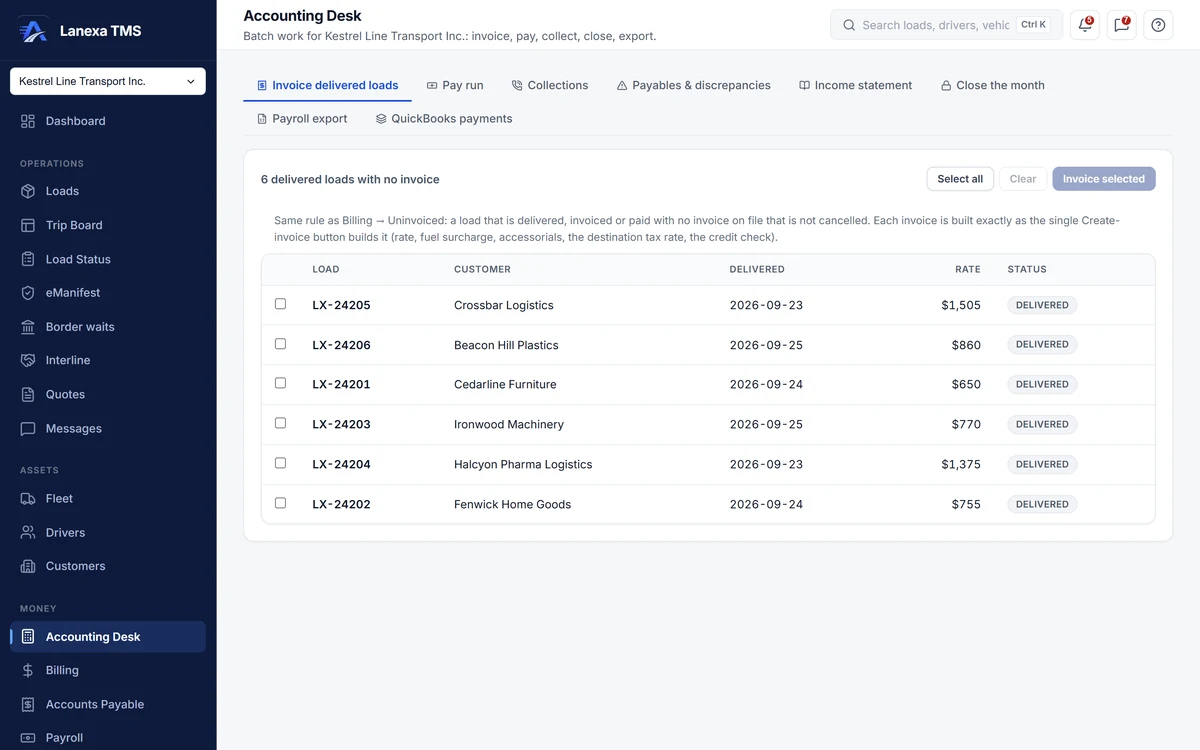
Billing is where a delivered load turns into a bill the customer actually receives, and where the company watches, chases, corrects and banks the money that comes back.
46 live
Accounts Payable
Accounts Payable is the screen where you enter every bill another carrier or vendor sends you, decide whether it is right, approve it, pay it, and keep the paper trail — so the money going *out* of the company is as controlled as the money coming *in*.
24 live
Ledger
The Ledger is the company's own set of books — every invoice, customer payment, carrier bill, bill payment, driver settlement and fuel receipt writes itself into a double-entry ledger automatically, and this screen lets you read those books, prove they balance, see where cash is heading, and click any number straight back to the paperwork it came from.
18 live
Payroll & Settlements
Payroll is where a freight company works out exactly what each driver has earned for a pay period — miles run, waiting time, fuel charged back, advances and loans — puts the numbers in front of a second person to sign off, and then records that the driver was actually paid.
47 live
Compliance, IFTA & Safety
This is where a carrier proves it is legal to be on the road — how many hours each driver has left, which licences and medicals are about to expire, what happened in every crash, and the quarterly fuel-tax return that has to be filed with the province or state that issued the plates.
40 live
Reports
Reports is where you pull the paperwork and the numbers out of the business — twenty-one ready-made registers you can run and download, four "everything about one truck / driver / trailer / customer" pages, and a build-your-own report tool that answers a plain-English question without ever inventing a number.
29 live
Can reachBilling, payables, payroll, the ledger and reports, with the money figures a Dispatcher does not get.
Cannot reachEntering and approving are deliberately different jobs. A billing clerk creates invoices and applies cash but cannot approve or void; a settlement needs a second person to release it.

Permission is a property of the person in that company, not of the person — so the same individual can hold a different role in each company they work in. How that works.