Who we serve / Dispatchers
The person holding it together

You are the integration layer. You shouldn't have to be.

A dispatcher spends the day re-typing between a board, a customs portal, an email thread and a phone — and gets blamed for whatever falls through the gaps between them.

01
The shipment gets typed three times
Once from the rate confirmation, once into the border filing, once again when billing asks what happened. Each retype is a chance to transpose a number nobody catches until the invoice is queried.
02
The border is somebody else's system
Separate portal, separate login, separate deadline — and if the filing is rejected, the load record has no idea.
03
Chasing drivers for paperwork
The proof of delivery exists, on a phone, somewhere. Getting it into the right place is a series of texts and a manual upload.
04
Nobody can see what you can see
The board lives in your head and in a spreadsheet. When you take a day off, the operation slows down.
PDF IN

The load fills itself in

Drop the broker's rate confirmation on the screen and the fields are extracted for you to check, rather than typed.

SAME RECORD

The filing comes off the load

ACE and ACI are prepared, validated and barcoded from the shipment you already built. No second system, no second typing.

NO APP

Documents come back on their own

Send a link; the driver photographs the missing document from their phone with no login, and it files itself against the right load.

Loads
This is the book of every shipment the company has agreed to haul — you write the job down here when a customer books it, you put a driver and truck on it, you watch it move from pickup to delivery, and the moment it delivers the system turns it into an invoice.
44 live
Trip Board
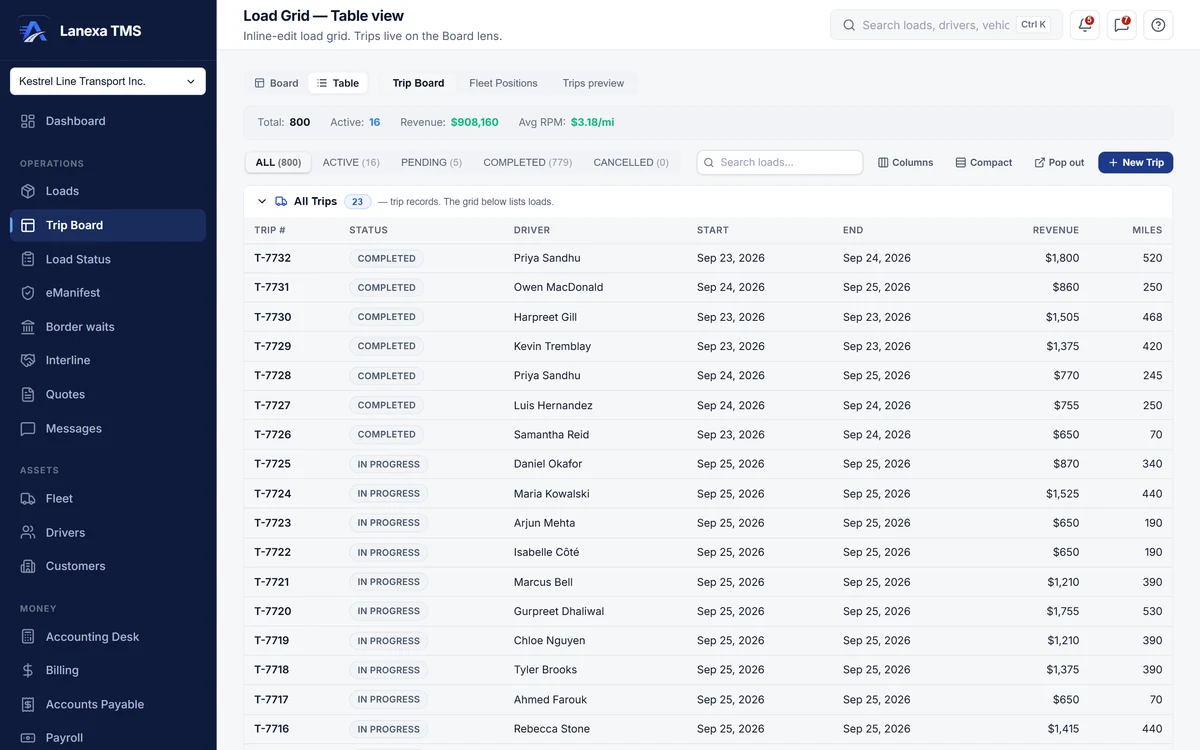
The Trip Board is the dispatcher's command centre — one screen that shows every truck currently working on top, every piece of booked freight waiting below, and lets the dispatcher build a run, put a driver and a truck on it, and tick off each stop as the day happens.
40 live
Load Status
Load Status is the wall a dispatcher watches all day — every shipment in the company shown as a card in a lane, on a map, or on a driver calendar, so that moving a load from "booked" to "on the truck" to "delivered" is one drag, and the system refuses the moves that would corrupt the money behind them.
36 live
eManifest
The eManifest module — called the Border Desk inside the product — is where a dispatcher gets a truck legally across the Canada/US border: it assembles every fact customs demands for a crossing, scores how ready that crossing is, prints the barcoded paper the driver carries, emails the customs broker their package, and runs a countdown clock so nobody arrives at the booth without an accepted filing.
29 live
Interline Desk
The Interline Desk is where you hand a load you already sold to another trucking company, watch them accept or decline the offer, send them the signed-rate paperwork, and get the bill you owe them created automatically the moment they deliver — while you stay the carrier the customer knows and invoices.
28 live
Unified Communications
Messages is the one place where every text, WhatsApp and email between your office and a driver, customer or broker lives as a running conversation — so nobody has to ask "did anyone reply to him?" ever again.
36 live
Can reachLoads, trips, the board, the border desk, partners and messages.
Cannot reachRates and margin are hidden from the Dispatcher role by default — visibility of money is a separate permission from access to a module, on purpose.

Permission is a property of the person in that company, not of the person — so the same individual can hold a different role in each company they work in. How that works.