Asset-light, customer-heavy

The loads you move and the loads you hand over, in one set of books.

Mixed operations usually run two systems — one for owned freight, one for farmed-out — and reconcile them by hand. Here both live on the same shipment record, so nothing is tracked twice and nothing falls between them.

01
Two systems, one P&L
Owned freight in one place, brokered freight in another, and a monthly exercise to make them agree.
02
Farmed-out margin is invisible until later
The cost you owe a partner arrives as an invoice long after the decision to use them was made.
03
Customers ask where their freight is
And answering means a phone call to a partner who may or may not pick up.
04
Nobody is sure which entity owns what
Especially once more than one operating company is involved.
ONE RECORD

Moved or farmed out, same shipment

The load stays yours commercially even when the wheels belong to a partner, and the board shows plainly which is which.

BOTH SIDES

Receivable and payable on one load

What the customer owes you and what you owe the partner post to the same double-entry ledger, against the same shipment.

SHARE

Visibility without a phone call

A branded tracking link your customer opens with no app and no login.

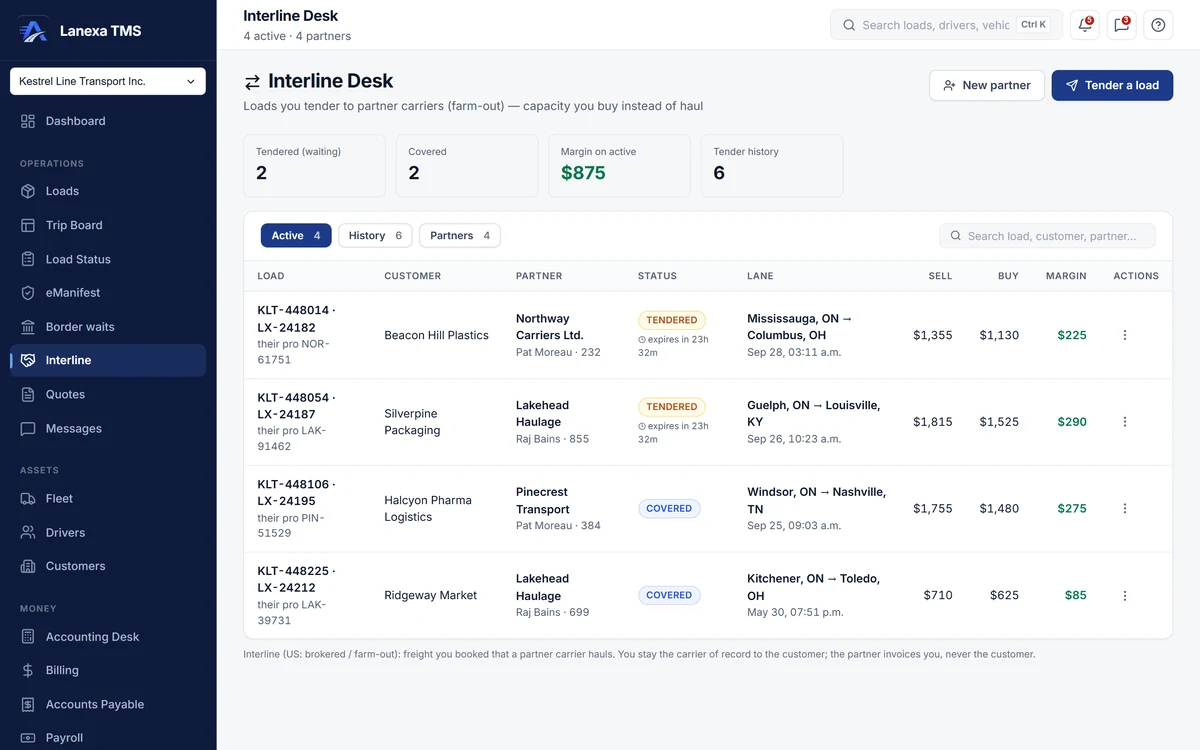
Interline Desk
The Interline Desk is where you hand a load you already sold to another trucking company, watch them accept or decline the offer, send them the signed-rate paperwork, and get the bill you owe them created automatically the moment they deliver — while you stay the carrier the customer knows and invoices.
28 live
Loads
This is the book of every shipment the company has agreed to haul — you write the job down here when a customer books it, you put a driver and truck on it, you watch it move from pickup to delivery, and the moment it delivers the system turns it into an invoice.
44 live
Customers
Customers is the one book of everyone who pays you — shippers, brokers, bill-to parties and interline partners — holding their contacts, their credit limit, what they owe you right now, the paperwork you insist on before you invoice them, and the fuel-surcharge terms you agreed to, so that dispatch, billing and the border desk all quote the same firm from the same record.
45 live
Billing
Billing is where a delivered load turns into a bill the customer actually receives, and where the company watches, chases, corrects and banks the money that comes back.
46 live
Ledger
The Ledger is the company's own set of books — every invoice, customer payment, carrier bill, bill payment, driver settlement and fuel receipt writes itself into a double-entry ledger automatically, and this screen lets you read those books, prove they balance, see where cash is heading, and click any number straight back to the paperwork it came from.
18 live
Multi-Company
When one owner runs several trucking companies side by side, this single screen adds them up — loads, revenue, trucks, trailers and drivers, each company in its own colour — so the owner can see the whole family of businesses at a glance without ever mixing their separate sets of books.
12 live