CustomersEvery shipper, broker and carrier, written down once.
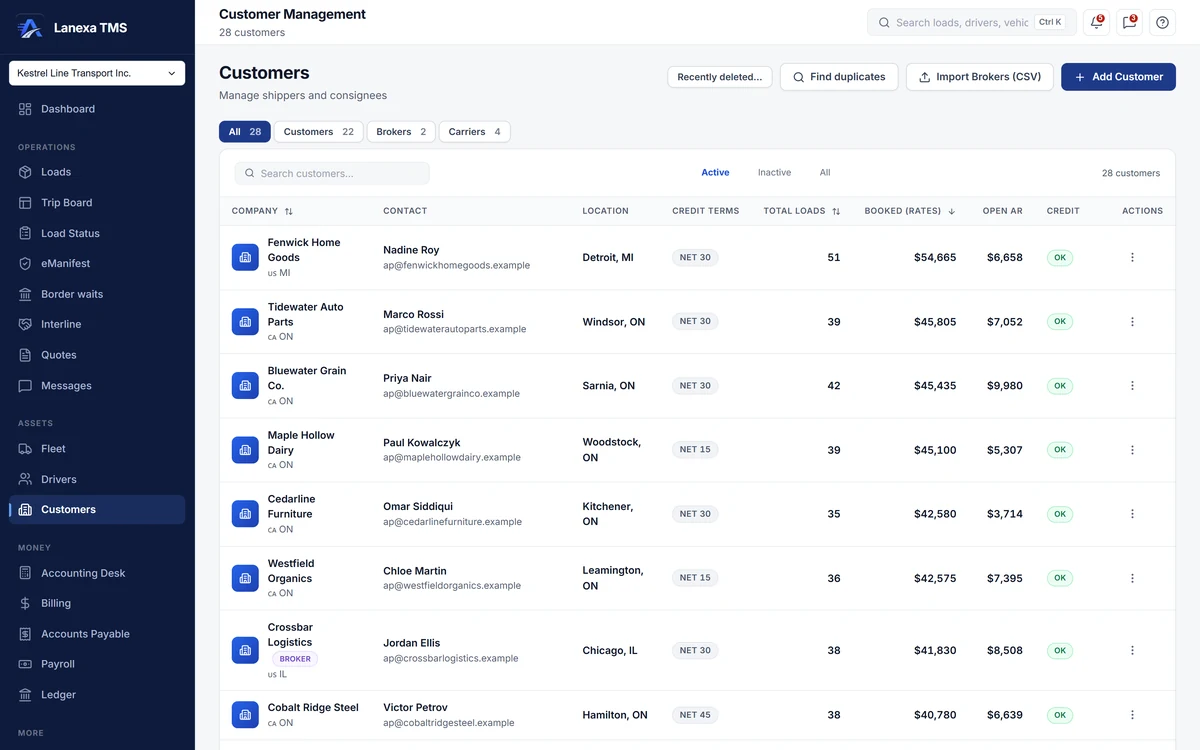
Customers holds every outside party you deal with — the shippers and brokers who pay you, and the carriers who haul for you — once, in the place dispatch, billing and the border desk all read.
What it does
What they owe, from real invoices
Open receivables, days to pay and a credit verdict — OK, near limit, on hold or no limit — are recomputed from live invoices every time, never read from a stored figure that drifts. Booked rates are labelled as booked, never as revenue. At the limit, a red banner sits on every tab of the customer's record.
Credit checked at booking
On Start and up, booking a new load for a customer at or over their credit limit is refused. Someone who can edit billing may tick "book anyway", and the override is recorded with the open balance, the limit and the percentage used. Editing an existing load is never blocked.
Check them against the FMCSA register
Look a broker or carrier up in the U.S. FMCSA register by USDOT or MC number, or by legal name when you have neither. You pick the right company; Lanexa saves its USDOT and shows authority, safety rating, out-of-service status and fleet size, with the date you checked.
Everyone at the customer, by what they handle
Name each contact with a title, email and phone, tag what they handle — invoices, dispatch, customs and more — and make one the primary in a click. Everyone can see who should get the invoice and who should get the delivery notice.
Paperwork before the invoice
On Start and up, require a signed POD, or a named list of documents such as a BOL and a scale ticket, before a customer's invoice can be raised. When a load is delivered without them, the delivery still records and the invoice waits, with the missing document named in the activity log.
A fuel surcharge that tracks diesel
On Start and up, set a customer's surcharge in cents per mile or percent of linehaul, pegged to the U.S. EIA weekly diesel index with your own base price and brackets. Preview what it bills against this week's index before you save; after that it prices itself on each invoice.
The detail, when you want it
Everything live in Customers12
- Customers, brokers and carriers in one book, with type tabs and live counts
- Search by name, contact or city; sort by loads or booked rates
- MC and USDOT badges on brokers and carriers
- Payment terms, a terms override and a credit limit in its own currency
- Detention free hours and an hourly rate per customer
- Find likely duplicates, preview what moves, then merge
- A health score with the signals behind it
- Every lane a customer ships, with average rate and margin where cost is captured
- One activity stream: loads, invoices, documents, notes and alerts
- Customer 360: money, aging by due date, on-time delivery and lanes on one page
- Import brokers from a CSV file
- Delete a customer and restore it; nothing attached to it is lost
Which plan includes itThe customer book — records, contacts, payment terms and FMCSA checks — is on every plan, including Solo, with 20 FMCSA lookups a day (100 on Start, 500 on Fleet and Enterprise).
The credit gate at booking, required-document rules, the diesel-indexed fuel surcharge, Customer 360, health scores and lane history, and duplicate merge are on Start and up. Compare plans
How we count204 live capabilities of 212 catalogued.
Each capability is one control, field, tile, column or disclosed number, counted one by one. The registry
Can Lanexa stop us booking more loads for a customer who is behind on paying?
Yes, on Start and up. Set a credit limit on the customer; once their open balance reaches it, a new load for them is refused at booking.
Someone who can edit billing may override it, and the override is recorded with the balance, the limit and the percentage used. Editing an existing load is never blocked.
How do the FMCSA lookups work?
From any customer, broker or carrier record, check the U.S. FMCSA register by USDOT or MC number, or search by legal name when you have neither.
You choose the matching company; Lanexa saves the USDOT and shows authority, safety rating, out-of-service status and fleet size. Solo includes 20 lookups a day, Start 100, Fleet and Enterprise 500.
Can a customer require a POD before we invoice them?
Yes, on Start and up. Tick "require POD before invoicing", or list the documents they need.
When the load is marked delivered without them, the delivery still records, no invoice is written, and the activity log names what is missing.